
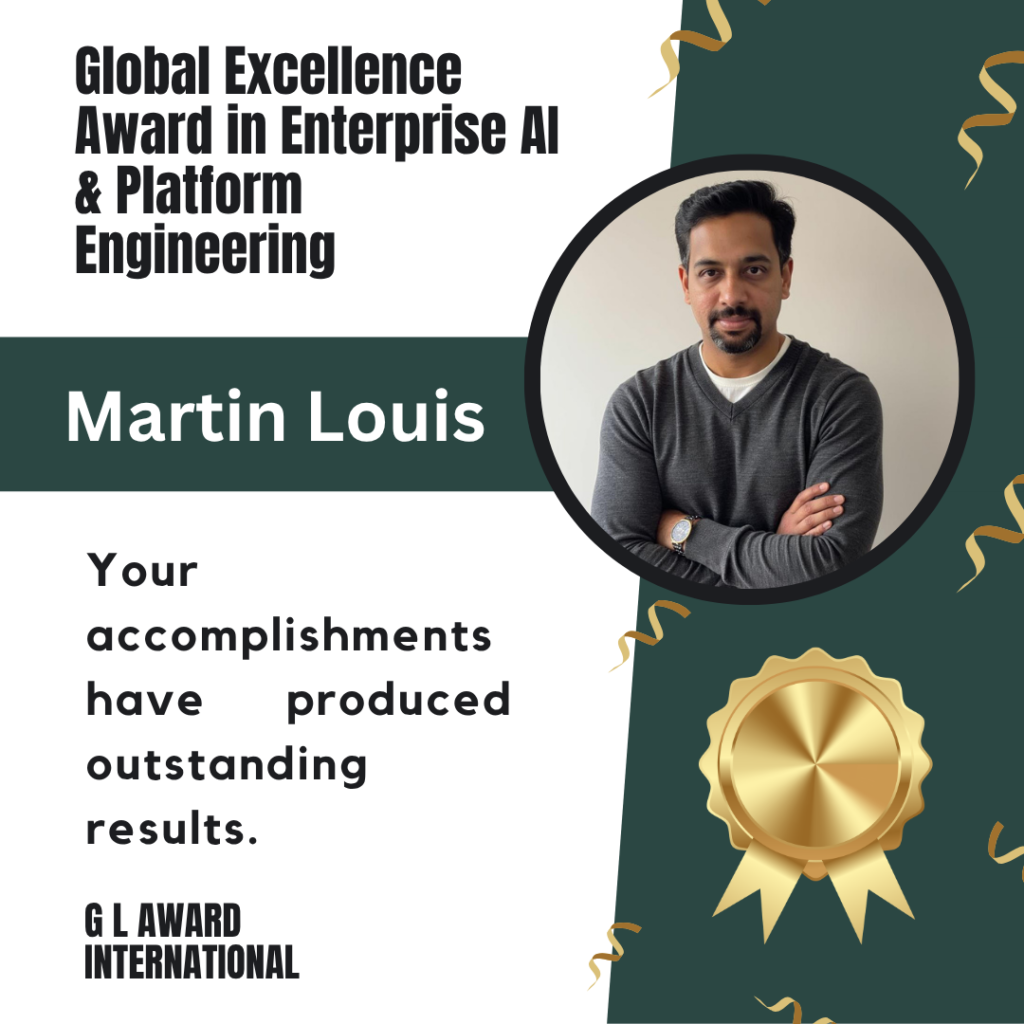
Martin Louis is an enterprise technology leader, Senior Engineering Manager, and technology practitioner whose work spans artificial intelligence, agentic systems, platform engineering, semantic search, knowledge graphs, cloud architecture, and product transformation.
With more than two decades of experience in software engineering and technology leadership, Martin has developed a career around a central question: How can organizations transform emerging technologies into scalable, reliable, and meaningful enterprise solutions?
Based in Austin, Texas, Martin currently serves as a Senior Engineering Manager at PayPal, where his professional experience includes enterprise platforms, AI-enabled systems, search and knowledge technologies, and engineering leadership.
His professional journey reflects the broader evolution of enterprise technology—from traditional software platforms and information systems toward intelligent, AI-native products and agentic workflows.
From Software Engineering to Enterprise AI
The technology landscape has changed dramatically over the past two decades.
Organizations have moved from conventional software applications toward cloud-native platforms, machine learning systems, semantic technologies, and now generative and agentic AI.
Martin Louis has worked across many stages of this transformation.
His experience includes software engineering, cloud services, enterprise search, knowledge management, semantic technologies, AI-enabled platforms, and engineering management.
This combination gives him a perspective that extends beyond individual AI models. Enterprise AI requires infrastructure, data, knowledge, security, governance, engineering processes, and product strategy to work together.
For Martin, the future of AI is therefore not simply about creating increasingly powerful models. It is about building the technology ecosystems that allow intelligent systems to operate reliably at enterprise scale.
Building AI-Native Enterprise Platforms
One of Martin’s primary areas of professional interest is the development of AI-native enterprise platforms.
Traditional enterprise software generally follows a predictable model: users interact with applications, applications interact with databases and APIs, and predefined business logic determines the outcome.
AI introduces a fundamentally different possibility.
Intelligent systems can interpret information, reason over enterprise knowledge, interact with tools, personalize experiences, and increasingly execute multi-step workflows.
This creates opportunities for organizations to rethink how software is designed.
Martin’s work and thought leadership explore this transition toward AI-enabled and agentic enterprise systems, where AI becomes an integrated component of the platform rather than an isolated feature.
His public professional work has included discussion of agentic AI, AI-native enterprise platforms, customer intelligence, semantic retrieval, knowledge graphs, and enterprise workflows.
Agentic AI and the Next Generation of Enterprise Software
Generative AI has already changed how people interact with technology.
The next stage is increasingly focused on agentic AI—systems capable of interpreting goals, using tools, maintaining context, coordinating actions, and operating across complex workflows.
Martin has written about the evolution of AI from conventional tools toward more autonomous systems, including his article From Tools to Teammates: The Rise of Agentic AI and the End of Incremental Transformation.
The significance of agentic AI goes beyond chatbots.
Enterprise agents can potentially assist with:
- Customer service workflows
- Knowledge discovery
- Content operations
- Product personalization
- Engineering workflows
- Enterprise search
- Decision support
- Proactive customer engagement
- Business process automation
However, deploying these systems responsibly requires more than connecting an LLM to an API.
Organizations need grounding, evaluation, observability, access controls, workflow state, security, governance, and human oversight.
That is where platform engineering becomes critical.
Knowledge Graphs, Semantic Search, and Enterprise Intelligence
Another important area in Martin Louis’s technology work is the relationship between knowledge graphs, semantic search, and enterprise AI.
Modern organizations hold enormous amounts of information across databases, documents, applications, APIs, customer records, and internal systems.
Traditional keyword search can struggle when users ask complex questions or when information exists across multiple disconnected sources.
Semantic search approaches the problem differently by focusing on meaning and context.
Knowledge graphs can add another layer by representing relationships between entities, concepts, products, customers, and events.
Together, these technologies can provide AI systems with richer contextual information.
This becomes especially important for enterprise applications where an AI model must produce answers grounded in organizational knowledge rather than relying solely on general-purpose training data.
Martin’s published professional work has included research and writing involving semantic search, product knowledge bases, multilingual search, and knowledge systems, reflecting his longstanding interest in intelligent information discovery.
Responsible AI and Trustworthy Technology
As organizations adopt AI at scale, technical capability must be accompanied by responsibility.
AI systems operating in enterprise environments can influence customer experiences, business decisions, operational processes, and access to information.
This makes AI governance, reliability, transparency, accountability, security, and responsible system design increasingly important.
Martin has contributed to discussions around trustworthy AI, including published work examining responsible AI design and approaches to improving reliability, transparency, accountability, and ethical considerations in large-scale AI systems.
The challenge is not simply determining whether an AI model is accurate.
Organizations also need to ask:
Can the system be trusted?
Can its behavior be evaluated?
Can its decisions be monitored?
Can humans intervene when necessary?
Can sensitive information be protected?
Can the system operate reliably at scale?
These questions are becoming fundamental to enterprise AI architecture.
Engineering Leadership in the Age of AI
Technology transformation is ultimately driven by people.
As a Senior Engineering Manager, Martin Louis brings together technical strategy, engineering execution, organizational leadership, and product thinking.
His experience includes working with engineering teams and multi-team organizations while helping translate complex technical challenges into scalable technology solutions.
Effective engineering leadership requires more than managing projects.
It involves building strong teams, mentoring engineers, encouraging innovation, establishing technical direction, managing trade-offs, and creating an environment where teams can solve difficult problems effectively.
In an AI-driven technology environment, engineering leaders must also help organizations understand where AI can create genuine value—and where conventional engineering approaches remain the better solution.
Enterprise AI Requires More Than AI Models
One of the defining characteristics of modern AI transformation is that the model itself is only one part of the overall system.
A production-grade enterprise AI solution may require:
Data → Knowledge → Retrieval → Models → Agents → Tools → Workflows → Evaluation → Governance → Observability
Each component contributes to the final user experience.
This is why Martin’s professional focus extends beyond artificial intelligence alone into platform engineering, cloud architecture, knowledge systems, search, product transformation, and engineering leadership.
The future of enterprise AI will increasingly belong to organizations that can integrate these disciplines effectively.
Technology Thought Leadership
Alongside his engineering leadership career, Martin Louis has contributed to technology discussions through articles, publications, and professional thought leadership.
His topics include:
- Artificial Intelligence
- Agentic AI
- Enterprise AI
- Large Language Models
- Knowledge Graphs
- Semantic Search
- Responsible AI
- Cloud Computing
- Product Transformation
- Engineering Leadership
- AI-Native Platforms
- Intelligent Enterprise Systems
His published work and professional writing reflect an interest in understanding not only what emerging technologies can do, but also how organizations can integrate them into real-world environments.
Looking Ahead: The AI-Native Enterprise
The next generation of enterprise technology will likely be defined by systems that are increasingly intelligent, contextual, connected, and autonomous.
Instead of simply interacting with applications, users may increasingly work with intelligent systems capable of understanding intent, retrieving organizational knowledge, coordinating tools, and executing multi-step processes.
For technology leaders, this transformation presents both an opportunity and a responsibility.
The opportunity is to create products and platforms that fundamentally improve how organizations operate.
The responsibility is to ensure those systems remain secure, reliable, explainable, measurable, and aligned with human objectives.
Martin Louis’s professional journey sits directly within this transition—from software engineering and enterprise platforms toward the emerging world of AI-native and agentic enterprise technology.
His work represents a broader technology leadership philosophy: build strong platforms, empower engineering teams, apply emerging technologies thoughtfully, and transform innovation into sustainable enterprise value.
Martin Louis — Technology Leadership at the Intersection of AI and Engineering
Martin Louis brings together more than 20 years of experience across software engineering, enterprise platforms, artificial intelligence, cloud technologies, knowledge systems, semantic search, and engineering leadership.
His work reflects the evolution of enterprise technology and the growing role of AI in shaping the future of products, platforms, and organizations.
For professional collaborations, technology discussions, speaking opportunities, publications, or industry engagements, Martin can be reached through his professional channels.